



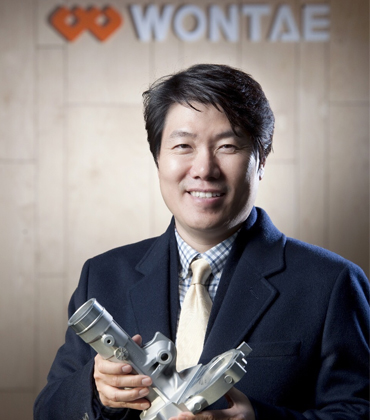
 Mr.Jinwon Ro, CEO & President of Wontae
WONTAE operates through a closed-loop engineering model that integrates mold design, die casting, post-processing and quality data within a single engineering system. Rather than functioning as separate stages, mold structure, gate and runner layout, cooling circuits, vacuum configuration and injection parameters are engineered together from the outset.
Before production begins, CAE-based flow and solidification analysis validate both mold design and casting conditions. By engineering and verifying these elements together, WONTAE consistently achieves OEM tolerances at the ±0.05 to 0.1 mm level and shortens the mass production stabilization phase after SOP. “WONTAE approaches die casting not as a 'casting technology' but as system engineering,” says H.S. Yoon, VP-Head of Sales and Purchasing.
Structured Control across Production
How are process control and quality planning embedded early in die casting production?
What differentiates WONTAE is how early it builds control into the process. During mold development, the team uses flow and solidification analysis to determine gate location, filling speed and injection rates before a single part is cast. This reduces porosity by 30 to 50 percent and consistently delivers process capability levels of Cpk 1.67 or higher. Once production begins, automated die-casting equipment continuously monitors injection speed, mold temperature and vacuum pressure in real time, minimizing lot-to-lot variations.
-
WONTAE approaches die casting not as a 'casting technology' but as system engineering.
WONTAE’s in-house mold design capability further strengthens this model. Unlike suppliers that rely on external tooling partners, the company eliminates the disconnect between design intent and production reality. Its mold designers work against the same KPIs as the casting floor, including porosity, shrinkage and deformation. As a result, design for manufacturing issues is addressed before production begins, and mold modification lead times during mass production are reduced by 30 to 40 percent.
Measurable Outcomes for Global OEMs
What operational outcomes do OEMs achieve through WONTAE’s integrated engineering model?
For OEMs, this system-driven approach translates into consistent operational outcomes. WONTAE stabilizes mass production within three months after SOP, maintains delivery compliance at 99 percent or higher and maintains zero major quality claims. Most critically, its supply reliability does not cause OEM line stops, a decisive factor in repeat contracts and long-term sourcing decisions.
Where Root-Cause Analysis Becomes Strategic Advantage
How does system-level root-cause analysis improve stability in complex die casting programs?
Clients value WONTAE as a partner that explains root causes rather than offering surface-level fixes. Instead of isolating defects at the inspection stage, the company traces them across mold design, casting behavior, material characteristics and process conditions.
By resolving issues at the system level, WONTAE reinforces production stability and long-term procurement confidence.The value of this system-focused approach became evident in a global OEM electrification project where third-party suppliers faced persistent machining and leak defects. By redesigning the mold cooling circuit and optimizing die-casting conditions, WONTAE reduced defect rates and shortened the production timeline. What began as an engagement evolved into a long-term program, which was later converted into a multi-year contract.
As automotive platforms demand higher precision and reliability, WONTAE is strategically strengthening its data-based quality prediction capabilities for large precision parts, robot components and other high-spec applications. By treating molds as core devices that ensure process stability and continuing to enhance data-driven production control, WONTAE continues to strengthen production stability and long-term OEM sourcing confidence.
